
The details of your Regenera Activa® treatment in Hamburg
Treatment duration | approx. 30 minutes |
|---|---|
Type of treatment | Autologous micro-graft treatment |
Pain | usually minimally painful |
Interval | usually once a year |
Indication | androgenetic alopecia with hair follicles still present |
|---|---|
Anesthesia | local anesthesia of the harvest site |
First results | possible after approx. 3 months |
Contraindication | tumor diseases, autoimmune diseases, pregnancy, and breastfeeding |

Hair therapy for hereditary hair loss – The Regenera Activa® method
From consultation to aftercare – The procedure of your treatment
Consultation & Anamnesis
First, we clarify the cause of your hair loss through anamnesis, examination, and a hair analysis. This is how we determine whether there are still hair follicles that can be activated and whether the procedure is an option for you.
Anesthesia & Harvesting
Under local anesthesia, we take three small skin punch biopsies of 2.5 millimeters from behind the ear. This area remains covered by hair later on; the procedure is minimally invasive, and any potential scar is very small.
The cell suspension
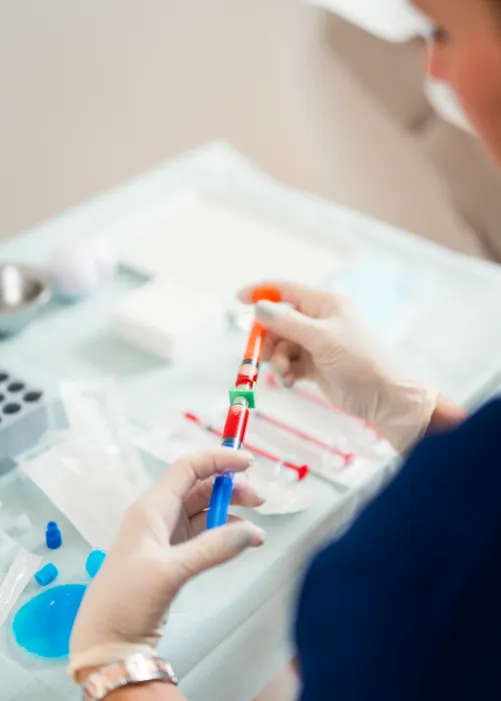
With the Regenera Activa® system, the harvested tissue is mechanically shredded, filtered, and a suspension of autologous cells, growth factors, and matrix components is obtained.
Injection into the scalp
We introduce the suspension evenly into the thinning areas via several fine punctures. Usually, only a brief sensation of pressure or stinging is felt, and the entire treatment takes about 30 minutes.
Aftercare & progress
Downtime is short: you can wash your hair again after about 24 hours. The progress becomes apparent over months; an initial assessment is possible no earlier than around three months.
Possible side effects
- Bleeding or hematoma at the puncture or harvest site
- Infection at the puncture or harvest site
- Short-term swelling, burning, or a feeling of tension
How Regenera Activa® stimulates your hair follicles – A scientifically supported treatment
Stopping miniaturization
In androgenetic alopecia, the growth phase of the hair shortens, the follicle shrinks, and the hair becomes finer. The treatment aims to intervene in this process and activate "dormant" hair follicles.
Autologous active ingredients
The core of the treatment is a micro-suspension consisting of intact, autologous (the body’s own) progenitor cells, growth factors, and the extracellular matrix for a favorable environment.
Cellular signaling
In the scalp, the isolated cells act as biological signal transmitters. They dock onto the miniaturized follicles and stimulate the dermal papilla cells to initiate regeneration.
The growth phase
Through this cellular impulse, the follicle can be returned to an active, extended growth phase (anagen phase), and the blood circulation of the scalp can be stimulated.
Structural improvement
The goal is to stop progressive hair loss and create the conditions for improved hair growth, allowing hair to regrow noticeably thicker and denser.
How we integrate this mode of action into our hair therapy concept
PRF as the main component
Further procedures
Are there also medicinal combinations?
Who is the treatment suitable for?
- hereditary hair loss
- thinning hair on the crown
- widening part
- hair follicles that are still present but weakened
- supplementary hair therapy before, during, or after a hair transplant
- completely bald areas without existing hair
- inflammatory hair loss
- scarring alopecia
- hair loss due to deficiencies or untreated underlying diseases
- pregnancy, breastfeeding, tumor diseases, or autoimmune diseases
Your appointment for Regenera Activa® treatment in Hamburg
Observing your own hair loss often costs a lot of energy. However, medical progress now offers us sound, minimally invasive ways to actively and purposefully counteract this process. In our private dermatology practice, we combine these scientific methods with honest, empathetic support.
We do not promise you miracles, but rather a transparent assessment of what is medically feasible – and what is not. The goal of our work is to give you back a bit of ease through precise diagnostics and coordinated therapies.
Therefore, take the first step and let us check together whether cellular stimulation is the right path for you.
Frequently asked questions about Regenera Activa®
Is the treatment equally suitable for men and women?
Is the result of the hair stimulation permanent?
Can I go straight back to exercising after the treatment?
Does a scar remain at the harvest site?
What is the difference between Regenera Activa® and PRF therapy?
Sources
- 1 Zari, S. (2021). Short-Term Efficacy of Autologous Cellular Micrografts in Male and Female Androgenetic Alopecia: A Retrospective Cohort Study. Clinical Cosmetic And Investigational Dermatology, Volume 14, 1725–1736. https://www.dovepress.com/short-term-efficacy-of-autologous-cellular-micrografts-in-male-and-fem-peer-reviewed-fulltext-article-CCID
- 2 Krefft-Trzciniecka, K., Piętowska, Z., Pakiet, A., Nowicka, D. & Szepietowski, J. C. (2024). Short-Term Clinical Assessment of Treating Female Androgenetic Alopecia with Autologous Stem Cells Derived from Human Hair Follicles. Biomedicines, 12(1), 153. https://www.mdpi.com/2227-9059/12/1/153
- 3 Vincenzi, C., Cameli, N., Pessei, V. & Tosti, A. (2024). Role of Autologous Micrografting Technology through Rigenera® System in the Treatment of Androgenetic Alopecia. Skin Appendage Disorders, 1–9. https://karger.com/sad/article/11/2/119/915014/
- 4 Gasteratos, K., Kouzounis, K. & Goverman, J. (2024). Autologous Stem Cell-derived Therapies for Androgenetic Alopecia: A Systematic Review of Randomized Control Trials on Efficacy, Safety, and Outcomes. Plastic & Reconstructive Surgery Global Open, 12(2), e5606.https://journals.lww.com/prsgo/fulltext/2024/02000/autologous_stem_cell_derived_therapies_for.48.aspx
- 5 Krefft-Trzciniecka, K., Piętowska, Z., Pakiet, A., Nowicka, D. & Szepietowski, J. C. (2024b). Short-Term Clinical Assessment of Treating Female Androgenetic Alopecia with Autologous Stem Cells Derived from Human Hair Follicles. Biomedicines, 12(1), 153. https://www.mdpi.com/2227-9059/12/1/153
- 6 Anlagebedingter Haarausfall beim Mann. (2025, 11. Mai). https://gesund.bund.de/anlagebedingter-haarausfall-beim-mann