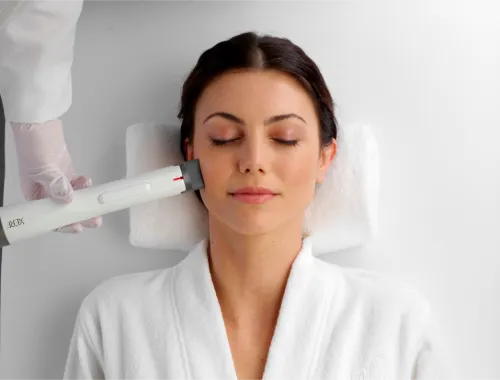
Your BTX Treatment for Migraine in Hamburg
Treatment Duration | Approx. 15 minutes |
|---|---|
Injection Sites | 31 according to the PREEMPT protocol |
Treatment Interval | Every 12 weeks |
Treatment Monitoring | Using a headache diary |
|---|---|
Treatment Goal | Fewer headache days |
Assessment | After 2–3 treatments |


When Migraine Dictates Your Life Plans
People living with chronic migraine have to plan their lives differently. A friend’s birthday, a Thursday meeting, a weekend trip – everything becomes uncertain, and there are hardly any symptom-free days between attacks. Many people affected have already tried several preventive medications: some did not provide sufficient relief, while others caused side effects they were no longer willing to tolerate.
Botulinum toxin A is approved for preventive treatment in precisely these circumstances: for adults with chronic migraine who have not responded adequately to preventive migraine medications or have been unable to tolerate them. This application has nothing to do with aesthetics. It is an established component of migraine therapy, as described in the current neurological guidelines.
Botulinum toxin A is approved for preventive treatment in precisely these circumstances: for adults with chronic migraine who have not responded adequately to preventive migraine medications or have been unable to tolerate them. This application has nothing to do with aesthetics. It is an established component of migraine therapy, as described in the current neurological guidelines.
Chronic Migraine – Who May Be Eligible for BTX Treatment?
When BTX Treatment May Be Appropriate
- You experience headaches on at least 15 days per month, with migraine features on at least eight of those days.
- This condition has persisted for more than three months.
- Preventive medications have not provided sufficient relief or have not been tolerated, usually after at least two treatment attempts.
- The diagnosis has been confirmed by a neurologist.
When Further Medical Evaluation May Be More Appropriate
- If you experience episodic migraine or tension-type headaches.
- If your headaches are new, unusually severe, or different from previous episodes – these should first be evaluated by a doctor.
- If your symptoms are more likely to result from nighttime teeth clenching – in this case, masseter treatment for bruxism may be more relevant.
How Does Botulinum Toxin Work for Migraine?
In wrinkle treatments, botulinum toxin temporarily relaxes specific facial muscles. For a long time, it seemed reasonable to assume that the same mechanism applied to migraine treatment. However, research now paints a different picture. The key appears to lie in the fine pain-sensing nerve fibers that run through the forehead, temples, back of the head, and neck and are connected to the pain-processing system of the meninges.
At these nerve endings, botulinum toxin inhibits the release of neurotransmitters such as CGRP and substance P, which are involved in the development of migraine pain. At the same time, fewer pain receptors reach the cell surface. As a result, these nerve fibers become less easily activated. The exact mechanism is not yet fully understood, and some findings come from laboratory and animal studies. However, large controlled clinical trials have demonstrated that the treatment is effective for chronic migraine. It follows a specific injection protocol that has little in common with aesthetic BTX treatments.
What Results Can You Expect from Treatment?
The two major PREEMPT trials included a total of 1,384 adults with chronic migraine. After 24 weeks, the average number of headache days per month decreased by 8.4 with botulinum toxin, compared with 6.6 with placebo. This represents an additional benefit of approximately 1.8 fewer headache days per month. A systematic Cochrane review reached a similar conclusion regarding the magnitude of the benefit.
However, such averages reveal little about how much an individual patient may benefit. Some people notice improvements after the first treatment cycle, while others need more time or do not respond sufficiently. Current clinical guidelines recommend assessing the results after two to three treatment cycles, each approximately three months apart. Complete freedom from symptoms cannot be guaranteed.

How BTX Treatment for Migraine Works
We review your neurological diagnosis, previous preventive treatments, and headache diary. Before starting treatment, we consider any potential contraindications and relevant medications you are taking.
The treatment is based on the PREEMPT protocol: typically 155 units injected at 31 predefined sites, with the option to increase the dose to a maximum of 195 units across up to 39 injection sites if medically necessary. Dosage is specific to the botulinum toxin product used.
Using a very fine needle, we inject small amounts into the forehead, temples, back of the head, neck, and upper shoulders. The procedure takes approximately 15 minutes, and you can usually return to your normal daily activities afterwards.
We repeat the treatment every 12 weeks. Your headache diary helps track how your migraine develops over time. After two to three treatment cycles, we evaluate the results together with your neurologist.
Possible Side Effects and Contraindications
- Neck pain, muscle stiffness, or temporary muscle weakness
- Headaches or a temporary worsening of migraine symptoms
- Pain, redness, or minor bruising at the injection sites
- Temporary drooping of the upper eyelid or changes in eyebrow position
- - Itching or skin rash
- Hypersensitivity to any of the ingredients in the botulinum toxin preparation
- Infections in the planned injection area
- Neuromuscular disorders or pre-existing swallowing difficulties
- Use of certain antibiotics from the aminoglycoside group
- Pregnancy and breastfeeding
One Component of a Comprehensive Approach – BTX as Part of an Overall Treatment Plan
Preventive Treatment | Administration | Frequency | Good to Know | Botulinum toxin (BTX) | Injections at 31 to 39 predefined sites on the head, neck, and shoulders | Every 12 weeks | Only for chronic migraine; acts locally and may therefore be suitable for many patients taking other medications or with cardiovascular risk factors |
|---|---|---|---|
Preventive medications, e.g. topiramate, beta blockers, amitriptyline | Oral tablet | Daily | Usually the first step in migraine prevention; tolerability and contraindications vary depending on the medication |
CGRP monoclonal antibodies | Subcutaneous injection, with one medication administered by infusion | Monthly or every 3 months | For episodic and chronic migraine; target the CGRP neurotransmitter or its receptor |
Gepants, e.g. atogepant | Oral tablet | Daily | A newer class of medications that also target the CGRP system |
Non-pharmacological approaches: endurance exercise, regular sleep-wake cycle, relaxation techniques, behavioural therapy | Integrated into daily life | Ongoing | Effective according to clinical guidelines; complement all forms of preventive treatment |
Your BTX Treatment Appointment for Migraine in Hamburg
Frequently Asked Questions About BTX Treatment for Migraine
Is the Treatment Also Suitable for Migraine with Aura?
Are the Injections Painful?
Does BTX Replace My Medication for Acute Migraine Attacks?
Will the Treatment Change My Appearance?
What Happens If the Treatment Does Not Work?
Quellenangaben
Baraldi, C., Lo Castro, F., Ornello, R., Sacco, S., Pani, L. & Guerzoni, S. (2023). OnabotulinumtoxinA: Still the Present for Chronic Migraine. Toxins, 15(1), 59. https://www.mdpi.com/2072-6651/15/1/59
Bendtsen, L., Sacco, S., Ashina, M., Mitsikostas, D., Ahmed, F., Pozo-Rosich, P. & Martelletti, P. (2018). Guideline on the use of onabotulinumtoxinA in chronic migraine: a consensus statement from the European Headache Federation. The Journal Of Headache And Pain, 19(1), 91. https://link.springer.com/article/10.1186/s10194-018-0921-8
Deutsche Gesellschaft für Neurologie & Deutsche Migräne- und Kopfschmerzgesellschaft. (2025). Therapie der Migräneattacke und Prophylaxe der Migräne (S1-Leitlinie, AWMF-Register-Nr. 030/057, Version 7.1). https://register.awmf.org/assets/guidelines/030-057l_S1_Therapie-der-Migraeneattacke-Prophylaxe-der-Migraene_2025-11.pdf
Dodick, D. W., Turkel, C. C., DeGryse, R. E., Aurora, S. K., Silberstein, S. D., Lipton, R. B., Diener, H. & Brin, M. F. (2010c). OnabotulinumtoxinA for Treatment of Chronic Migraine: Pooled Results From the Double‐Blind, Randomized, Placebo‐Controlled Phases of the PREEMPT Clinical Program. Headache The Journal Of Head And Face Pain, 50(6), 921–936. https://headachejournal.onlinelibrary.wiley.com/doi/10.1111/j.1526-4610.2010.01678.x
Fachinformation BOTOX® 50/100/200 Allergan-Einheiten. (2026, August). AbbVie Deutschland. https://www.fachinfo.de/fi/pdf/020408
Headache Classification Committee of the International Headache Society (IHS) The International Classification of Headache Disorders, 3rd edition. (2018). Cephalalgia, 38(1), 1–211. https://journals.sagepub.com/doi/10.1177/0333102417738202
Herd, C. P., Tomlinson, C. L., Rick, C., Scotton, W. J., Edwards, J., Ives, N., Clarke, C. E. & Sinclair, A. (2018). Botulinum toxins for the prevention of migraine in adults. Cochrane Database Of Systematic Reviews, 2018(6), CD011616. https://www.cochranelibrary.com/cdsr/doi/10.1002/14651858.CD011616.pub2/full
Pozo-Rosich, P., Alpuente, A., Silberstein, S. D. & Burstein, R. (2024). Insights from 25 years of onabotulinumtoxinA in migraine — mechanisms and management. Nature Reviews Neurology, 20(9), 555–568. https://www.nature.com/articles/s41582-024-01002-5
Ruscheweyh, R., Förderreuther, S., Gaul, C., Gendolla, A., Holle-Lee, D., Jürgens, T., Neeb, L. & Straube, A. (2018). Therapie der chronischen Migräne mit Botulinumneurotoxin A. Der Nervenarzt, 89(12), 1355–1364. https://link.springer.com/article/10.1007/s00115-018-0534-0