
Details of Your Masseter Treatment in Hamburg
Treatment Duration | approx. 15–30 minutes |
|---|---|
Downtime | none |
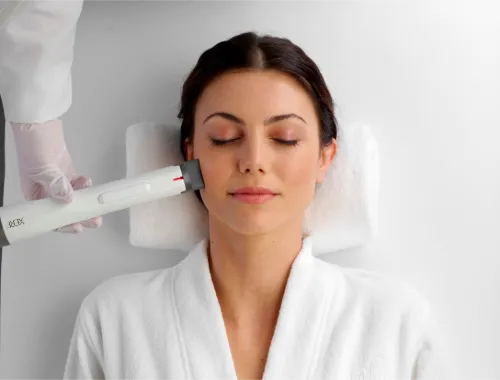
Diagnostics | Palpation and ultrasound examination of the masseter muscle |
Duration of Effect | several months |
Anaesthesia | usually not necessary |
|---|---|
Onset of Effect | usually after 1–2 weeks |
Change in Contour | over the course of several weeks |
Follow-up Appointment | after approx. 2–4 weeks |
Attending Doctors






Overactive Masseter? How Botox Can Relieve the Jaw Muscle!
Do you clench your teeth at night, or does your lower jaw appear broader than you would like? Both observations are often caused by an overactive masseter, the large chewing muscle located at the angle of the jaw.
During masseter treatment, we inject botulinum toxin specifically into this muscle to temporarily reduce its strength. What masseter Botox in Hamburg may mean for you is discussed during your assessment: the aim may be to relieve strain on the jaw and teeth in cases of bruxism – meaning teeth grinding and jaw clenching – to make the contour of the lower jaw appear softer, or to achieve both at the same time.
You can conveniently book your consultation appointment online or by telephone at the practice.
Masseter Botox – The Treatment Process
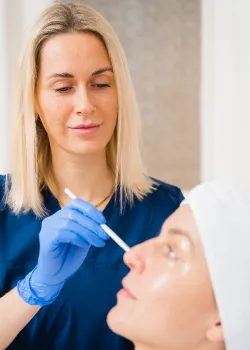
During the consultation, we assess your symptoms, possible contributing factors and your desired treatment goal. We then examine the chewing muscles clinically and with the help of ultrasound in order to assess the strength, structure and symmetry of the masseter.
Based on the findings, we determine which areas of the muscle should be treated. The injection points and distribution of the botulinum toxin are adapted to your anatomy as well as to the functional or aesthetic treatment goal.
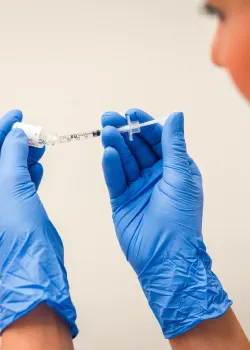
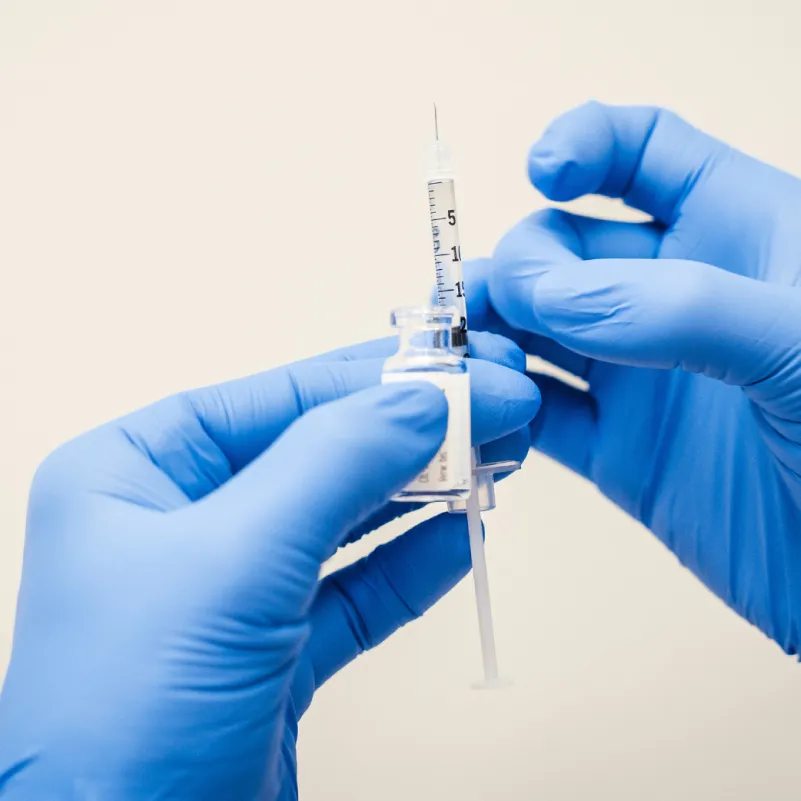
Using a fine needle, we inject the botulinum toxin precisely at several points into the lower, deeper portion of the muscle, keeping a safe distance from the muscles that shape your smile. Anaesthesia is generally not necessary, and you can leave the practice immediately afterwards.
After the treatment, you will receive instructions for the first few hours, including guidance regarding exercise, sauna use and massage, as well as appropriate aftercare. Initial changes usually become noticeable within one to two weeks. A possible reduction in muscle volume develops over several weeks.
What Does Off-Label Use Mean?
One Active Ingredient, Two Applications
For Bruxism and TMD
People who grind their teeth at night or unconsciously clench them during the day often place strain on their teeth, temporomandibular joints and muscles for years. Typical consequences include jaw pain in the morning, tension headaches and worn tooth structure. Botulinum toxin is intended to reduce the strength of the masseter with the aim of decreasing pressure. In cases of TMD, we view the injection as one component alongside a splint, physiotherapy and stress management, not as a replacement for them.
For Masseter Hypertrophy
A masseter that has been heavily used over many years will increase in volume like any other trained muscle. The lower jaw can then appear more angular and wider, sometimes unevenly on the two sides. If the muscle is weakened with Botox, it works less and may gradually reduce in size over several weeks, allowing the contour to appear softer. Whether the width is actually caused by the muscle or by the underlying bone structure is assessed through palpation and ultrasound examination.
How Does Botulinum Toxin Work in the Jaw Muscle?
For the masseter muscle, our strongest muscle in the body, to contract, the nerve endings release a neurotransmitter called acetylcholine. Botulinum toxin blocks this release at the sites where it is injected. The muscle is not completely paralysed, but rather “dimmed”, similar to a light that does not switch off but becomes less bright. The extent of this reduction is controlled through the dose, adjusted to your individual findings and treatment goal.
For people with bruxism, another distinction is important and is often overlooked on informational websites. The impulse to grind and clench the teeth does not originate in the muscle, but in the nervous system, often during sleep or periods of tension. The treatment does not alter this impulse. Studies measuring muscle activity suggest that the number of episodes remains largely unchanged, while the force with which the muscle bites down during these episodes decreases. This is where the potential relief for the teeth and temporomandibular joints lies.
Why the Effect Is Temporary
Who Is the Treatment Suitable For?
Treatment may be considered if …
- your jaw muscles are clearly pronounced or overactive on palpation and ultrasound examination.
- you continue to experience jaw pain, a feeling of pressure or morning tension despite using a splint, relaxation exercises or physiotherapy.
- you have TMD in which the muscles play a significant role and the injection is intended to form one component of the overall treatment.
- your lower jaw appears wider and the examination shows that this width is caused by the muscle.
- you expect the grinding itself to stop. The treatment reduces the force, not the impulse.
- you want to replace your splint. It continues to protect the teeth and remains part of the treatment.
- the width of the lower jaw is caused by the underlying bone structure, as botulinum toxin does not change the bone.
- you are under 18 years of age, pregnant or breastfeeding, have a neuromuscular disorder such as myasthenia gravis, or have inflammation in the treatment area.
Possible Side Effects and Contraindications
- Reactions at the injection sites: redness, swelling, tenderness or small bruises
- Temporary symptoms: headaches or an unfamiliar feeling of tension in the treated area
- Changes when chewing: reduced chewing strength or faster fatigue of the jaw muscles
- Changes in facial expression: a temporarily altered smile if neighbouring muscles are affected
- Changes in facial contour: asymmetry, excessive narrowing or uneven contours
- Localised muscle bulging: visible protrusion of part of the masseter when the muscle is tensed
- Rare, more serious symptoms: difficulty swallowing, speaking or breathing, which require immediate medical assessment
- Pregnancy or breastfeeding
- Infections or inflammation in the treatment area
- Certain neuromuscular disorders
- Known hypersensitivity to components of the product
- Medications that affect signal transmission between nerves and muscles
- An increased tendency to bleed or certain anticoagulant medications
Your Appointment for Masseter Botox in Hamburg
Whether you grind your teeth at night, clench during the day or feel that your lower jaw is too wide: at our practice, the assessment always comes first, including a consultation, palpation and ultrasound examination of the masseter muscle. Afterwards, you will know whether treatment with botulinum toxin is appropriate in your case, what it can achieve and where its limitations lie. In some cases, we may also recommend having the dental aspect assessed first.
The easiest way to arrange your consultation for masseter Botox in Hamburg is directly here – at the private practice of Dr. Anna Brandenburg.
Frequently Asked Questions About Masseter Botox
Does the Treatment Stop Teeth Grinding?
Can I Eat Normally After the Treatment?
Is the Treatment Safe in the Long Term?
Does Health Insurance Cover the Costs?
Is Masseter Treatment Also a Treatment for Headaches or Migraines?
Can I Continue Wearing My Occlusal Splint?
Sources
AWMF Leitlinienregister. (o. D.-b). https://register.awmf.org/de/leitlinien/detail/083-027
Nl. (2026, 7. Juli). Update Bruxismus-Leitlinie: Das ist neu! Das News-Portal der Zahnärztlichen Mitteilungen. https://www.zm-online.de/news/detail/update-bruxismus-leitlinie-das-ist-neu
Fedorowicz, Z., Van Zuuren, E. J. & Schoones, J. (2013). Botulinum toxin for masseter hypertrophy. Cochrane Database Of Systematic Reviews, 2013(9), CD007510. https://www.cochranelibrary.com/cdsr/doi/10.1002/14651858.CD007510.pub3/full
Machado, G., De Freitas, L., Ribeiro, L., Andrade, G., Silva, V., Da Silva, T., Lima, V., Rezende, P., Almeida, T., Torres, F. & Kreutz-Rodrigues, L. (2026). Efficacy of botulinum toxin for masseter muscle hypertrophy: A systematic review and meta-analysis. Journal Of Plastic Reconstructive & Aesthetic Surgery, 119, 212–225. https://www.jprasurg.com/article/S1748-6815(26)00354-2/abstract
Jung, B. K., Park, H., Cheon, Y. W., Yun, I. S., Choi, J., Kim, H. J., Lee, M. Y., Kang, B. S. & Kang, T. J. (2023). Clinical investigation of botulinum toxin (prabotulinumtoxin A) for bruxism related to masseter muscle hypertrophy: A prospective study. Journal Of Cranio-Maxillofacial Surgery, 51(5), 332–337. https://www.sciencedirect.com/science/article/abs/pii/S1010518223000768?via%3Dihub
Nishikawa, A., Aikawa, Y. & Kono, T. (2024). Treatment of masseter muscle hypertrophy with botulinum toxin type A injection: A review of adverse events. Journal Of Cosmetic Dermatology, 23(11), 3544–3550. https://onlinelibrary.wiley.com/doi/10.1111/jocd.16462
Grinberg, N. & Peleg, O. (2025). Parotitis Induced by Botulinum‐Toxin Injections to the Masseter Muscle. Journal Of Cosmetic Dermatology, 24(2), e70052. https://onlinelibrary.wiley.com/doi/10.1111/jocd.70052
Owen, M., Gray, B., Hack, N., Perez, L., Allard, R. J. & Hawkins, J. M. (2022). Impact of botulinum toxin injection into the masticatory muscles on mandibular bone: A systematic review. Journal Of Oral Rehabilitation, 49(6), 644–653. https://onlinelibrary.wiley.com/doi/10.1111/joor.13326